
Dooly County Criminal Docket Searches
A Dooly Superior criminal case starts at Georgia Courts E-Access. Choose Dooly Superior there. Then follow the path into PeachCourt. Expect an account wall. There is no guest name search. PeachCourt lets non-attorneys register for free, though both the results screen and the document screen still demand a login.
Gather the defendant's name, the exact case number, the court name, the charge or citation, and any paper setting notice before you search. A name match alone proves little. Confirm the county before you trust anything else. Then check the court class, the case type, and the latest entry before you treat a result as the correct Dooly County criminal docket.
- Read the citation, accusation, indictment, bond, or notice to identify the court and case number.
- Use Georgia Courts E-Access for a Dooly Superior case, or call the local office for Magistrate, municipal, or juvenile matters.
- Open the matching case and separate charges, settings, motions, status, disposition, and document images.
- Check the latest entry and confirm the next date with the clerk when the hearing is close.
- Request a plain or certified copy from the custodian if the online record is incomplete.
Superior Means Felony Trial Court
The Superior Court is the one with broad civil and criminal authority. Georgia Courts says it holds every felony trial. So Dooly County Superior Court holds the county's main criminal docket for felony cases. The county lists no separate Dooly State Court. So do not route a misdemeanor to a local State Court docket search without checking with a clerk first.
Magistrate Court handles warrants, preliminary matters, and minor criminal work. Vienna and Unadilla Municipal Courts keep the city traffic and ordinance cases. Juvenile Court follows its own confidentiality rules. A municipal citation can still be criminal in character. It may never appear in the Dooly Superior provider.
The Georgia court-class guide explains these levels. The Dooly County Clerk page gives the local Superior route.
Criminal Dockets: What They Show
The exact PeachCourt field labels for Dooly cases are visible only through an authorized account. What follows is the expected shape of a criminal docket. Keep in mind that a docket entry is not the same thing as a charging document or a final order.
| Case number | The unique court identifier printed on the notice or clerk record. No Dooly prefix was verified, so do not invent a format. |
|---|---|
| Charge | The accusation, indictment, citation, or other charging entry. Read the cited statute from the source document. |
| Bond and arraignment | Release, first appearance, and plea-related entries. A bond entry is not a finding of guilt. |
| Settings | Pretrial, calendar call, trial, motion, or sentencing dates with a status such as reset or continued. |
| Disposition | The outcome or closing status, such as dismissal, plea, verdict, sentence, dead docket, or nolle prosequi when applicable. |
Read the case status, the latest order, and the disposition as one picture. A single docket line can be terse, and an image may be unavailable even when the event itself is public.
Dooly’s PeachCourt Login Wall
PeachCourt's access page wants an email and password before anything opens. There is a registration link but no guest search. Signing up is free. It asks for your name, email, password, a secret question and answer, a CAPTCHA, and your agreement to the terms. An account still doesn't guarantee that every Dooly criminal entry is free to view.
Vendor help pages describe what to expect inside. Many file-stamped documents may be available. Images run $0.50 per page, plus a small convenience fee. Sealed, adoption, and unexecuted proposed-order materials are excluded. Not every document is online at all. Once you log in, confirm Dooly coverage, image availability, and the current charges.
If a Superior case will not appear, the Clerk of Superior Court is the safest fallback. Ask the clerk whether the matter sits in municipal court, Magistrate, or Juvenile. It may instead be restricted, sealed, transferred, or simply not yet indexed. The Dooly County court records route walks through requesting a paper or certified copy from the office that holds it.
For lower-court matters, the Dooly Probate contact page can help. It posts the office's phone and contact details for reaching that court's staff.
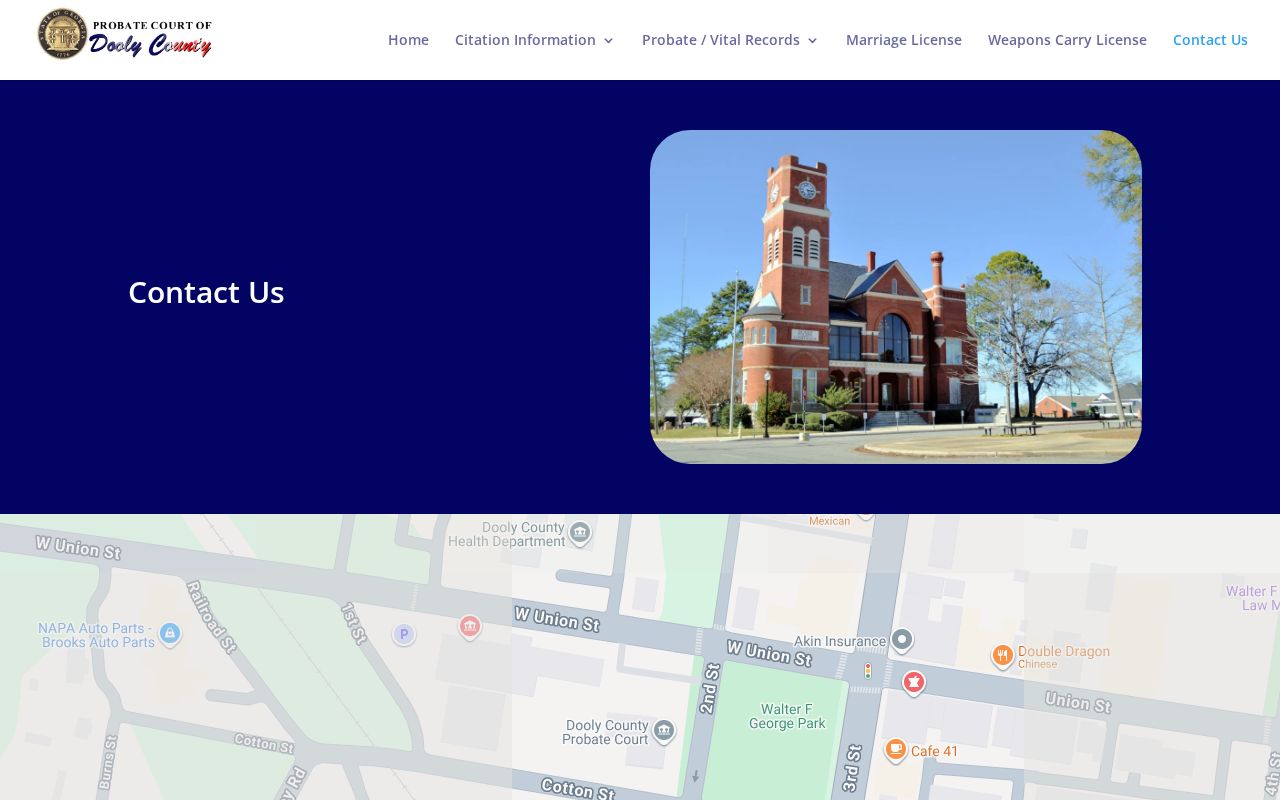
That Dooly Probate contact page matters when the record is a citation, warrant, or Probate matter. It is not a Superior criminal docket portal.
Criminal Case Stages on the Docket
A criminal docket is a case record in time order. The exact sequence varies, but entries usually run from a charging instrument through court settings to a final outcome.
Docket flow: Charge Filed › Warrant or Bond › Arraignment › Motions and Pretrial › Calendar Call › Trial or Plea › Disposition › Sentencing or Closure
An indictment and an accusation are two different charging routes. A plea is a formal response, not the sentence. A dead docket is an inactive criminal status, and it is not an acquittal. For any entry that affects a pending matter, get the underlying order and talk with a licensed Georgia attorney.
The Cordele Circuit Criminal Map
Dooly Superior sits in the Cordele Judicial Circuit alongside Ben Hill, Crisp, and Wilcox Counties. Circuit materials also identify an Adult Felony Drug Court program. That program is a court track within the circuit. It is not a separate Dooly courthouse and not a public participant database.
Dooly publishes no participant list, specialty calendar, eligibility form, or public treatment docket. A specialty case can still generate Superior docket events. Treatment and supervision detail may be restricted, though. Ask the Superior Clerk or circuit administration whether a public calendar exists. Never infer a program outcome from a short docket line.
The Judicial Council accountability-court material is the source of the circuit reference. It does not disclose private participant names.
Dooly County Criminal Docket Courts
The court name drives the search. Dooly Superior is the felony trial route, while Magistrate handles warrants and preliminary work. Vienna and Unadilla keep the municipal citation and ordinance records. Juvenile files are confidential and offer no public Dooly case search. The county directory lists the local Superior, Probate, and Magistrate offices. But it publishes no public Juvenile clerk page.
| Criminal need | Custodian or route | Access note |
|---|---|---|
| Superior felony | Georgia Courts E-Access, PeachCourt, Clerk of Superior Court | Account route; no public sample fields observed. |
| Warrant or preliminary matter | Dooly Magistrate/Probate office | No public search form; ask which record is public. |
| Vienna or Unadilla citation | City clerk or city vendor | Separate from PeachCourt and county Superior records. |
| Juvenile case | Juvenile clerk or authorized JDEX route | Article 9 confidentiality; no public names or result set. |
One Office Handles Probate and Magistrate
Dooly County merged two benches into one office. Senate Bill 111 made the Probate Judge the Chief Magistrate for matters on or after January 1, 2021. So one judge now wears both hats. The county Magistrate page names Rooney Bowen III at 104 South Second Street, Room 11, Vienna. The phone is 229-268-4217. Treat this as a lower-court route, though. It is not a stand-in for a Superior Court felony docket.
The two sides of the office post different hours for the same room. The county Magistrate page says 8:30 a.m. to 5:00 p.m. on weekdays. The Probate site says 8:00 a.m. to 4:30 p.m. Given that mismatch, a quick call is wise. Do it before you drive over about a warrant, a citation record, or a case date.
The Dooly Probate records page states that most Probate records are open for research. Wills deposited for safekeeping are the exception; those stay sealed in the vault.
That vault rule matters when you read a Dooly County docket. It keeps an estate or lower-court file from being confused with an open Superior criminal docket. For citation, Probate, and vital-record navigation, the Dooly Probate Court home page is the official source.
Use the Probate site for what it actually covers: citations and vital records. It is not a general Superior criminal search.
Access Rules for Criminal Dockets
Georgia starts from open court access. Sealed filings, protected identifiers, juvenile records, adoption material, and restricted criminal-history information all sit outside that default. Rule 21 demands a process for limiting access. So when a portal entry is missing, the gap alone tells you nothing about why.
Rules to check
Uniform Superior Court Rule 21 addresses public court records and the procedure for an access limitation.
Rule 21.6 and O.C.G.A. § 9-11-7.1 concern protected identifiers and redacted public filings.
O.C.G.A. § 35-3-37 provides a restriction process for certain criminal-history records; it is not a guarantee that every local or vendor copy disappears.
O.C.G.A. § 15-11-701 and Georgia Juvenile Code Article 9 support confidentiality for juvenile files and records.
What if a criminal record is withheld? Ask the office holding it whether the item is sealed, restricted, redacted, juvenile, or just absent from the online case lookup. Request the legal basis for any denial. You can also ask for whatever non-exempt portion of the court record can be produced.
Dead Docket Is Not Conviction
Status words on a criminal docket are not interchangeable. A dead docket usually marks an inactive case under local practice. It is neither a conviction nor an acquittal. Nolle prosequi is a prosecution-termination notation, and the signed order holds the exact disposition. A bond entry? It shows release or security details, never a final result.
- Arraignment
- A criminal stage where the charge and plea process are addressed.
- Disposition
- The recorded result that resolves a case or a particular event.
- Continuance
- A court-authorized move of a setting.
- Sealed
- A court-ordered access limit that may block a public view or document image.
Always pair the latest docket entry with the case status and the signed order. Is the record sparse? The Clerk of Superior Court can confirm what the public file actually contains. Whether an entry changes a pending case is a legal question. Only a court or a licensed attorney can answer that one.